

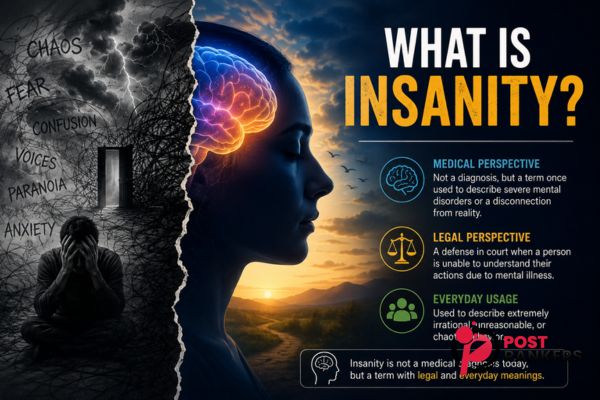
What is insanity? The word usually describes an extreme state of mental disturbance, irrational thinking, or a serious inability to understand reality. However, the term has different meanings depending on the context. Modern mental health professionals generally do not use “insanity” as a formal psychiatric diagnosis, while the legal system uses it as a specific concept related to criminal responsibility and mental capacity.
What Is Insanity?
The simplest answer to “what is insanity” is that insanity is a broad term traditionally used to describe severe mental disturbance that affects a person’s ability to think, understand reality, or control behavior. In everyday conversation, people often use the word casually to describe something extremely unreasonable or chaotic. However, that informal use differs greatly from its legal meaning.
In modern medicine and psychology, professionals usually avoid treating insanity as a specific diagnosis. Instead, they identify particular mental health conditions, symptoms, and patterns of behavior. For example, a professional may discuss psychosis, delusions, severe mood symptoms, or impaired judgment rather than simply labeling someone “insane.” This approach provides greater accuracy and reduces confusion around mental health.
The Definition of Insanity Explained
The definition of insanity changes depending on how people use the word. In general language, it may refer to a severe loss of rational judgment or an apparent inability to understand reality. Historically, however, the word appeared in medical, psychological, and legal discussions before modern diagnostic systems developed more precise terminology.
Today, the legal definition carries the greatest formal importance. In criminal law, insanity generally refers to a mental condition that may prevent a person from understanding the nature of an act, recognizing its wrongfulness, or controlling behavior under certain legal standards. Because laws differ between jurisdictions, no single definition applies everywhere.
What Is Insanity in Psychology?
In psychology, “insanity” does not represent one specific mental disorder or official diagnosis. Instead, mental health professionals use recognized diagnostic terms to describe symptoms and conditions. These terms allow clinicians to evaluate a person’s thoughts, emotions, behavior, perception, and ability to function with much greater precision.
A person experiencing serious mental health symptoms may struggle with reality testing, judgment, memory, impulse control, or emotional regulation. Nevertheless, the presence of a mental illness does not automatically mean that someone is legally insane. Clinical diagnosis and legal responsibility involve different questions, standards, and evaluation processes.
What Is Legal Insanity?
Legal insanity is a legal concept used in some criminal cases when a defendant argues that a severe mental disease or defect affected their ability to understand their actions or recognize their wrongfulness at the time of an alleged offense. The exact standard depends on the jurisdiction and the legal test used by the court.
Importantly, legal insanity does not simply mean that a person has a mental illness. Courts focus on the person’s mental state during the alleged offense and apply specific legal standards. Therefore, a diagnosis alone does not establish legal insanity. Judges and juries ultimately determine whether the applicable legal requirements have been met.
The Insanity Defense
The insanity defense allows a defendant to argue that a mental disease or defect prevented them from meeting the legal requirements for criminal responsibility. Different jurisdictions use different approaches, including tests that focus on whether the defendant understood the nature of the act or knew that the conduct was wrong.
Some legal standards also examine whether a person had substantial capacity to appreciate the wrongfulness of conduct or to conform behavior to the law. Because criminal law varies by jurisdiction, the exact rules can differ significantly. Consequently, anyone facing a real legal matter needs advice from a qualified attorney in the relevant jurisdiction.
Insanity Versus Mental Illness
Mental illness and insanity are not interchangeable terms. Mental illness refers to a wide range of recognized health conditions that can affect a person’s emotions, thoughts, behavior, and daily functioning. Insanity, by contrast, usually describes either an outdated general expression or a legal conclusion involving criminal responsibility.
A person can have a mental illness and still understand the nature of their actions and recognize that those actions are wrong. Conversely, a legal insanity determination depends on the specific facts and legal standard involved. This distinction matters because casual assumptions can create misunderstandings about both mental health and criminal law.
Common Misunderstandings About Insanity
One common misconception suggests that anyone who behaves strangely or experiences unusual thoughts must be insane. That assumption is inaccurate and can reinforce harmful stereotypes. Mental health symptoms exist on a broad spectrum, and only a qualified professional can evaluate a person’s condition through an appropriate assessment.
Another misunderstanding treats an insanity defense as an automatic escape from criminal consequences. In reality, legal systems impose strict standards, and the outcome of a successful insanity defense depends on the jurisdiction. A person may face court-ordered psychiatric treatment, secure hospitalization, or other legal consequences rather than simply walking free.
How Courts Evaluate Legal Insanity
Courts generally examine evidence related to a defendant’s mental condition and mental state at the time of the alleged offense. Evaluations may involve psychiatric or psychological experts, medical records, witness accounts, behavior before and after the event, and other relevant evidence. However, experts provide opinions while the legal system applies the governing legal standard.
The court’s central question often involves whether a mental disease or defect affected the person’s ability to understand the nature or wrongfulness of their actions. Some jurisdictions apply different tests, so the outcome can depend heavily on local law. For that reason, legal insanity remains a complex issue involving both mental health evidence and legal judgment.
Why the Word “Insanity” Can Be Misleading
The word “insanity” can create confusion because people use it in several different ways. Someone might use it casually to describe an unbelievable event, while a lawyer might use it to discuss a formal criminal defense. Meanwhile, a mental health professional may avoid the term entirely because it lacks the precision of modern clinical language.
Using more specific terms often leads to clearer communication. Instead of describing someone as insane, it may be more accurate to discuss a particular symptom, diagnosis, or legal finding. This distinction supports more respectful conversations about mental health and prevents people from confusing unusual behavior with a formal medical or legal conclusion.
What Is Insanity in Everyday Language?
In everyday speech, people often use “insanity” as an exaggerated expression. Someone might describe an unbelievable sports performance, an extreme situation, or a chaotic event as “insane.” In this context, the word does not necessarily refer to mental illness or legal responsibility.
However, everyday language can sometimes blur important distinctions. When people use mental health terms casually, they may unintentionally reinforce negative stereotypes. Therefore, choosing precise language becomes especially important when discussing real mental health conditions, psychological symptoms, or criminal cases involving mental capacity.
The Difference Between Insanity and Incompetence
Legal insanity and incompetence are also different concepts. Insanity generally concerns a person’s mental state at the time of an alleged offense, while competency to stand trial concerns whether a defendant can understand court proceedings and assist their attorney. These questions involve different points in time and different legal standards.
A person may be competent to stand trial but still raise an insanity defense concerning their mental state during the alleged offense. Likewise, someone may be unable to participate meaningfully in legal proceedings without necessarily meeting the legal definition of insanity. This distinction helps explain why courts treat these issues separately.
Conclusion
So, what is insanity? The term generally describes extreme mental disturbance in everyday language, but modern psychology does not use it as a specific psychiatric diagnosis. In law, insanity has a narrower meaning involving mental capacity and criminal responsibility, and the exact definition varies by jurisdiction. Understanding these distinctions makes the subject clearer, more accurate, and less stigmatizing. Ultimately, the meaning of insanity depends heavily on whether the discussion involves everyday speech, mental health, or the legal system.
