

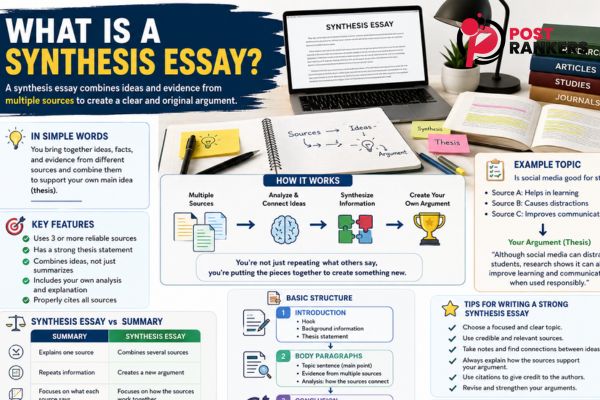
If you are wondering what is a synthesis essay, the simplest answer is that it is an academic essay that combines ideas from multiple sources to develop a clear argument, explanation, or perspective. Instead of discussing sources separately, a synthesis essay connects their ideas and uses evidence to support the writer’s own central position. This approach requires reading, comparison, critical thinking, and thoughtful analysis.
What Is a Synthesis Essay?
A synthesis essay brings together information from several sources and combines that information into one organized discussion. The writer studies different viewpoints, identifies relationships between them, and develops a thesis based on the evidence. Therefore, the essay does more than summarize articles, books, studies, or other materials. It shows how separate ideas connect to create a stronger understanding of a specific topic.
The word “synthesis” means combining different elements to form something new. In academic writing, that process involves examining multiple sources and using their ideas to support an original argument. For example, a student writing about social media and education might use research about student performance, expert opinions about digital learning, and studies about online communication to build one clear position.
How a Synthesis Essay Differs from a Research Essay
A synthesis essay and a traditional research essay may look similar because both require sources and evidence. However, they serve different purposes. A research essay often focuses on presenting information about a topic, while a synthesis essay emphasizes the relationships between sources and the writer’s interpretation of those relationships. As a result, synthesis writing demands more comparison and analysis.
A strong synthesis essay does not simply explain what Source A says, followed by what Source B says. Instead, the writer examines how the sources agree, disagree, expand upon, or challenge one another. This connection creates the foundation for the essay’s argument. Consequently, the writer remains an active thinker rather than becoming a passive reporter of information.
The Main Purpose of a Synthesis Essay
The primary purpose of a synthesis essay is to develop a meaningful argument by combining information from different sources. Writers use this format to demonstrate that they understand a topic from multiple perspectives. More importantly, they show that they can evaluate evidence and use it to support an independent conclusion based on logic and credible information.
Synthesis essays also help students develop advanced academic writing skills. The process requires careful reading, source evaluation, note-taking, organization, and critical thinking. Furthermore, students must learn how to identify important evidence instead of including every detail they find. This ability becomes increasingly valuable in college, professional research, journalism, business analysis, and many other fields.
Common Types of Synthesis Essays
Several types of synthesis essays exist, and each one serves a slightly different purpose. An argumentative synthesis essay uses multiple sources to support a specific position on a debatable issue. An explanatory synthesis essay, on the other hand, combines information to explain a complex subject without necessarily arguing for one side.
A review synthesis essay evaluates information from different sources to present an overall understanding of a subject. Meanwhile, some academic assignments ask students to compare competing perspectives before reaching a conclusion. Although the formats may differ, every successful synthesis essay connects sources rather than treating each one as an isolated piece of information.
How to Write a Synthesis Essay Step by Step
Writing a synthesis essay becomes easier when you follow a structured process. First, understand the assignment and identify the exact question you must answer. Then, gather reliable sources that provide different perspectives on the topic. After that, analyze the sources, organize related ideas, develop a thesis, and create a logical essay structure.
1. Understand the Essay Prompt
Before researching, read the assignment carefully and identify its main requirements. Look for action words such as analyze, compare, evaluate, explain, or argue because these words reveal the type of response your instructor expects. Additionally, determine the required number of sources, formatting rules, word count, and evidence expectations before beginning the writing process.
A clear understanding of the prompt prevents irrelevant research and weak arguments. For instance, a question asking whether artificial intelligence improves education requires a different approach from a question asking how artificial intelligence has changed education. The first question invites an argument, while the second primarily requires explanation and synthesis.
2. Research and Evaluate Multiple Sources
A synthesis essay depends heavily on the quality of its sources. Choose materials that provide useful evidence, credible information, and different viewpoints. Academic studies, books, government publications, expert interviews, and reputable publications can all contribute valuable information, depending on the assignment and subject.
However, simply collecting many sources will not automatically create a strong essay. You should evaluate each source carefully and ask what evidence it provides, whether the author appears credible, and how the source connects to your topic. This process helps you avoid weak information and keeps your argument focused.
3. Create a Source Connection Chart
A source chart can help you identify relationships between different materials. Write each source in a separate section and record its main argument, supporting evidence, important examples, and connection to other sources. Then, look for patterns that reveal agreement, disagreement, similarities, differences, or developing ideas across the research.
For example, three sources about remote learning might agree that technology increases access to education. However, one source might emphasize flexibility, another might discuss student motivation, and a third might examine unequal access to devices. These connections can become the major points of a well-organized synthesis essay.
4. Develop a Strong Thesis Statement
Your thesis statement should present the central idea or argument of your essay. A strong thesis does more than announce the topic. Instead, it explains the position you will develop through your analysis of multiple sources. The thesis should also give readers a clear sense of the essay’s direction and purpose.
For example, a weak thesis might state, “Social media affects college students.” This statement introduces a topic but offers no specific argument. A stronger thesis could argue that social media can support academic collaboration and communication, but excessive use may reduce concentration and negatively affect academic performance.
Recommended Synthesis Essay Structure
Most synthesis essays follow a structure that includes an introduction, several body paragraphs, and a conclusion. Each section serves a specific purpose, so organization matters greatly. A clear structure allows readers to follow the argument while understanding how different sources contribute to the writer’s overall position.
Introduction
The introduction should introduce the topic and provide enough background for readers to understand the issue. It should then narrow the discussion toward the main question or debate. Finally, the introduction should present a clear thesis that explains the central argument or interpretation developed throughout the essay.
Body Paragraphs
Each body paragraph should focus on one major idea connected to the thesis. Begin with a topic sentence that introduces the paragraph’s main point. Then, present evidence from multiple sources when appropriate, explain the relationships between those sources, and analyze how the evidence supports the overall argument.
A useful body paragraph often follows this pattern: claim, evidence, comparison, and analysis. The writer makes a point, introduces relevant information, connects different sources, and explains the significance of that connection. Therefore, the analysis remains more important than simply listing quotations or facts from research materials.
Using Sources Effectively
When using sources, avoid allowing quotations to dominate your writing. Instead, introduce evidence with context, explain its relevance, and connect it directly to your argument. Paraphrasing can also help you integrate information smoothly, provided you accurately represent the original meaning and properly follow the required citation style.
Strong synthesis occurs when sources interact within the same discussion. For example, one source might provide statistical evidence while another offers an expert explanation for those results. By connecting the two, the writer creates a more complete analysis than either source could provide alone.
Conclusion
The conclusion should bring the main argument together without simply repeating the introduction. Summarize the most important relationships between the sources and explain what the combined evidence reveals. You can also discuss the broader significance of the topic, especially when the research suggests important consequences or future questions.
A strong conclusion leaves readers with a clear understanding of the argument and its importance. However, it should not introduce a completely new major point that the essay never developed. Instead, the final paragraph should demonstrate how the evidence and analysis successfully support the thesis.
Common Mistakes to Avoid
Many students struggle with synthesis essays because they summarize sources instead of analyzing them. A paragraph that explains one source, followed by another paragraph about a different source, may provide information but fail to create genuine synthesis. Always focus on relationships between ideas and explain why those relationships matter.
Another common mistake involves using evidence without analysis. A quotation or statistic cannot prove an argument by itself. The writer must explain what the evidence means and how it supports the central claim. Additionally, weak organization, an unclear thesis, unreliable sources, and excessive quotation can reduce the effectiveness of an otherwise well-researched essay.
Final Thoughts on What Is a Synthesis Essay
Understanding what is a synthesis essay becomes much easier when you remember its central purpose: connect ideas from multiple sources to create a clear, well-supported argument or explanation. A successful essay does not merely collect information. Instead, it compares perspectives, evaluates evidence, identifies meaningful relationships, and uses those connections to develop the writer’s own analysis.
Ultimately, the strongest synthesis essays balance research with original thinking. By understanding the prompt, choosing credible sources, creating meaningful connections, developing a focused thesis, and analyzing evidence carefully, you can write an essay that feels organized, persuasive, and academically strong. The goal is not simply to repeat what sources say but to show what their combined ideas reveal.
