

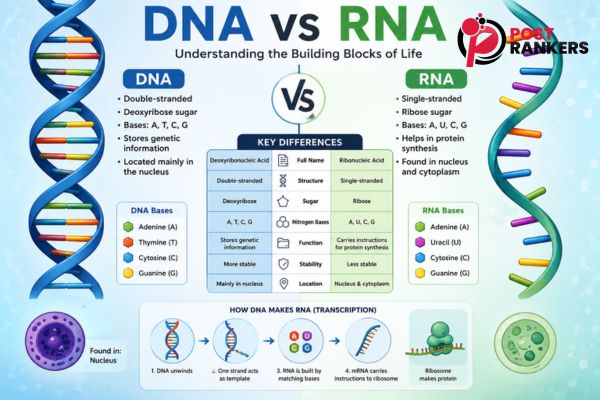
When comparing dna vs rna, the biggest difference comes down to their roles in managing genetic information. DNA acts as the long-term storage system for hereditary instructions, while RNA helps copy, interpret, regulate, and use those instructions inside cells. Although both molecules belong to the nucleic acid family, their structures and functions make them uniquely suited to different biological tasks.
What Are DNA and RNA?
DNA, or deoxyribonucleic acid, stores the genetic instructions that guide the growth, development, functioning, and reproduction of living organisms. Nearly every cell in the human body contains DNA, primarily inside the nucleus. Because DNA can preserve genetic information for long periods, it serves as the stable biological blueprint passed from one generation to the next.
RNA, or ribonucleic acid, performs a more flexible range of tasks within cells. It can carry genetic instructions, help build proteins, regulate gene activity, and support important cellular reactions. Unlike DNA, RNA usually exists as a single strand, which allows it to fold into different shapes and perform specialized functions throughout the cell.
DNA vs RNA: The Major Differences
The clearest way to understand dna vs rna involves comparing their sugar molecules, nitrogenous bases, structures, stability, and biological roles. These differences may seem small at the molecular level; however, they strongly influence how each molecule behaves. DNA favors long-term information storage, whereas RNA supports active communication and cellular activity.
1. DNA and RNA Have Different Sugars
DNA contains a sugar called deoxyribose, while RNA contains ribose. The difference involves one oxygen atom attached to the sugar’s structure. Ribose contains an additional hydroxyl group, which makes RNA more chemically reactive. Consequently, RNA generally breaks down more easily than DNA under certain conditions.
This structural distinction explains why DNA works well as a durable genetic archive. RNA, meanwhile, benefits from greater chemical flexibility. Cells can create and remove many RNA molecules quickly, allowing them to respond rapidly to changing conditions, developmental signals, and environmental demands without altering the permanent DNA sequence.
2. Their Nitrogenous Bases Are Not Identical
Both DNA and RNA use adenine, cytosine, and guanine as nitrogenous bases. However, DNA uses thymine, while RNA uses uracil. This difference creates one of the most recognizable distinctions in molecular biology. During complementary base pairing, adenine pairs with thymine in DNA but pairs with uracil in RNA.
The base-pairing rules help molecules copy and interpret genetic information accurately. DNA typically forms stable pairs between complementary strands, while RNA can pair with itself or other nucleic acid strands in different ways. Therefore, the base difference contributes to their distinct structures and biological functions.
3. DNA Is Usually Double-Stranded, While RNA Is Usually Single-Stranded
DNA commonly forms a double helix made from two complementary strands. This arrangement provides stability and allows one strand to serve as a template when the cell copies genetic information. The famous twisted-ladder shape also protects important genetic instructions by keeping the bases inside the molecule’s structure.
RNA generally exists as a single strand, although it can fold into complex three-dimensional shapes. These shapes allow different RNA molecules to perform specialized jobs. For example, folded RNA can help recognize molecules, transport amino acids, regulate genes, or contribute to the structure and activity of cellular machinery.
4. DNA Stores Genetic Information, but RNA Helps Use It
The primary role of DNA involves storing the instructions encoded in genes. A gene contains information that can help produce a protein or functional RNA molecule. DNA therefore serves as the long-term reference that cells protect and copy when organisms grow, reproduce, or repair tissues.
RNA helps transform genetic information into cellular action. Messenger RNA carries instructions from DNA to ribosomes, where cells build proteins. Other RNA molecules support that process or regulate gene expression. In simple terms, DNA preserves the information, while RNA helps deliver and apply it.
How DNA and RNA Work Together
The relationship between DNA and RNA becomes clearer through gene expression. First, a specific section of DNA provides a template for producing messenger RNA through transcription. Next, the messenger RNA carries the genetic instructions to a ribosome. The ribosome then reads the message and assembles amino acids into a protein.
This process shows why neither molecule operates independently in most cells. DNA provides the original instructions, while RNA acts as an important intermediary and functional molecule. As a result, the connection between DNA, RNA, and proteins forms a central foundation of molecular biology and helps explain how genes influence cellular behavior.
The Three Main Types of RNA
Messenger RNA, commonly called mRNA, carries genetic instructions from DNA to ribosomes. Transfer RNA, or tRNA, delivers specific amino acids during protein production. Ribosomal RNA, known as rRNA, forms a major structural and functional component of ribosomes. Together, these RNA types help cells translate genetic information into proteins.
Beyond these three major types, scientists have identified many additional RNA molecules with regulatory and specialized functions. Some RNA molecules influence whether genes become active, while others help process genetic messages or protect cellular systems. Consequently, modern biology recognizes RNA as far more than a simple messenger between DNA and proteins.
Which Molecule Is More Stable?
DNA is generally more stable than RNA because of its chemical structure and double-stranded design. Its deoxyribose sugar lacks the additional hydroxyl group found in ribose, reducing certain chemical reactions that can damage the molecule. The double helix also provides a backup copy of genetic information when one strand becomes damaged.
RNA offers flexibility rather than maximum long-term stability. Cells can produce specific RNA molecules when needed and break them down afterward. This temporary nature suits processes that require quick responses. For example, a cell may increase certain messenger RNA molecules when it needs to produce more of a particular protein.
DNA vs RNA in Viruses
The comparison between dna vs rna also becomes important when studying viruses. Some viruses use DNA as their genetic material, while others use RNA. Their genetic material can influence how they replicate, mutate, and interact with host cells. However, the exact behavior depends on the specific virus and its replication strategy.
RNA viruses often experience genetic changes more rapidly because many RNA replication systems have less proofreading ability than the systems used by many DNA-based organisms. Still, scientists should avoid treating every RNA virus identically. Different viruses use different enzymes and mechanisms, so their mutation rates and biological behavior can vary considerably.
Why the Difference Matters in Biology
Understanding DNA and RNA helps explain genetics, inherited traits, protein production, biotechnology, and modern medical research. Scientists study DNA when they investigate genetic information and hereditary changes. They examine RNA when they analyze gene activity, cellular responses, protein production, and certain disease processes.
These molecules also play important roles in laboratory science. Researchers can analyze DNA to identify genetic variations or amplify specific sequences. Meanwhile, RNA analysis can reveal which genes are active in particular cells or tissues. Therefore, learning the difference between DNA and RNA provides a foundation for understanding many areas of modern biology.
A Simple Way to Remember DNA vs RNA
A useful memory aid is to think of DNA as the permanent library and RNA as the working copy or active assistant. DNA keeps the complete collection of genetic instructions safe, while RNA selects, carries, interprets, and sometimes regulates specific information. This comparison simplifies the concept without ignoring the complex functions these molecules perform.
Remember the key differences: DNA contains deoxyribose and thymine, usually forms a double helix, and primarily stores genetic information. RNA contains ribose and uracil, usually forms a single strand, and performs several roles connected to gene expression and cellular regulation.
Conclusion
The comparison of dna vs rna reveals how two closely related molecules can perform remarkably different jobs. DNA provides stable, long-term storage for genetic instructions, while RNA offers flexibility by carrying messages, helping build proteins, regulating genes, and supporting cellular processes. Their differences in sugar, bases, structure, stability, and function allow them to work together efficiently. Understanding this partnership makes genetics and molecular biology far easier to understand.
