

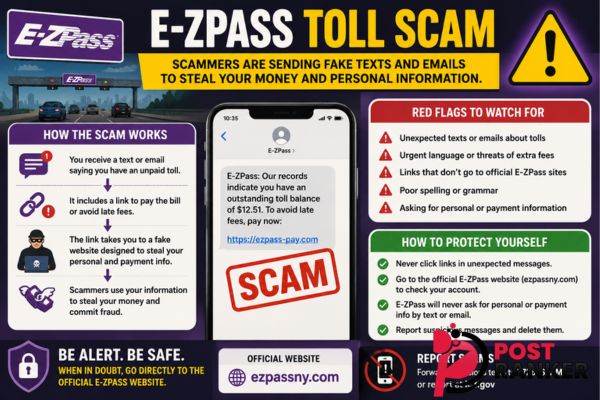
You’re going about your day when your phone buzzes. A text message tells you that you have an unpaid toll balance, your driving privileges are at risk, and you need to pay immediately or face serious fines. It looks official. It feels urgent. And that’s exactly the point. The E-ZPass toll scam has exploded across the United States, targeting millions of drivers with frighteningly convincing fake messages designed to steal your money and your personal information. Before you tap that link, read this.
What Is the E-ZPass Toll Scam?
The E-ZPass toll scam is a form of “smishing” a cybercrime that combines SMS text messaging with phishing tactics. Scammers impersonate E-ZPass, one of the most widely used electronic toll collection systems in the country, to trick drivers into handing over payment details and sensitive personal data. Because E-ZPass operates across 20 states primarily in the East, Midwest, and South, its name carries enough brand recognition to make a fake message feel entirely believable.
The scam isn’t new the FBI issued its first warning about it back in April 2024. But it surged dramatically in 2025, triggering public alerts from the FBI, the FCC, and dozens of state DMVs and Departments of Transportation. By March 2025, the FBI’s Internet Crime Complaint Center had already logged more than 60,000 complaints nationwide. That number kept climbing as scammers ramped up their campaigns with increasingly sophisticated tactics, including AI-generated messages that are far harder to detect than the typo-riddled phishing emails of years past.
Why E-ZPass? Why Now?
Scammers are strategic. They don’t pick random targets they pick trusted names that millions of people interact with regularly. E-ZPass fits that profile perfectly. Furthermore, the fear of fines, license suspensions, and government penalties makes toll-related threats unusually effective at triggering panic. When people feel scared and pressured, they act fast and think slow. That psychological dynamic is the entire engine driving this scam.
Additionally, the sheer volume of text spam in circulation right now gives these scammers remarkable reach. Americans received an estimated 19.2 billion spam and scam texts in April 2025 alone roughly 63 per person. Even a tiny response rate on that scale translates into massive profits for criminal networks operating these campaigns.
How the E-ZPass Toll Scam Actually Works
Understanding the mechanics of this scam is the single best way to protect yourself from it. Here’s exactly how it plays out from start to finish.
Step 1 — They Get Your Number
Scammers don’t guess phone numbers. They obtain them through data brokers, dark web databases, previous data breaches, or Telegram marketplaces where stolen information gets bought and sold in bulk. This is why people who have never used E-ZPass in their lives still receive these messages. The scammers aren’t targeting E-ZPass customers specifically they’re casting an enormous net and catching whoever responds.
Step 2 — They Send the Fake Text
The message arrives with a tone of urgency that’s hard to ignore. A typical example reads something like: “Your toll payment for E-ZPass Lane must be settled immediately. To avoid fines and the suspension of your driving privileges, kindly pay by the due date.” Some versions claim you owe a specific dollar amount often a small, believable number like $3.87 or $12.45 to make the message feel more legitimate. The texts often arrive from random email addresses or international phone numbers, both of which are red flags that are easy to miss when you’re reading quickly.
Step 3 — The Fake Payment Page
If you click the link, it takes you to a convincing but entirely fraudulent website designed to mimic the real E-ZPass portal. The page will ask for your credit card number, billing address, and sometimes your Social Security number or driver’s license information. Once you enter those details, the scammers have everything they need to drain your accounts, open new lines of credit in your name, or sell your information to other criminals on the dark web.
The Red Flags You Need to Know
Spotting the E-ZPass toll scam before it catches you requires knowing what genuine E-ZPass communication looks like and what it doesn’t.
What Real E-ZPass Texts Will Never Do
Real E-ZPass messages will never ask you to reply with “Y” to receive a payment link. Legitimate texts come from verified short codes, not random email addresses or international numbers starting with country codes like +63. Real messages will never threaten immediate license suspension over a small unpaid balance, and they will never pressure you to click a link and pay within 24 to 48 hours or face escalating penalties.
Other Warning Signs to Watch For
Beyond the message itself, the link URL is a major tell. Official E-ZPass websites use clearly branded, government-adjacent domain names. Scam links often use lookalike domains slight misspellings or added words like “ezpass-invoice.com” or “toll-payment-center.net” that look legitimate at a glance but fall apart under scrutiny. Moreover, if the text arrives when you haven’t traveled on a toll road recently, that alone should raise your suspicion immediately.
What to Do If You Receive a Suspicious Text
Receiving one of these messages doesn’t mean you’ve been compromised it means scammers got your number, which unfortunately happens to almost everyone at some point. The key is how you respond.
First and most importantly, do not click the link. Don’t reply to the text, don’t call any number listed in the message, and don’t engage in any way. Simply receiving the text cannot harm you only interacting with it can. If you’re genuinely concerned about whether you have an outstanding toll balance, go directly to the official E-ZPass website by typing the address manually into your browser, or log into your existing account through the official app.
How to Report the Scam
Reporting these messages actively helps authorities track and shut down these operations. You can forward the suspicious text to your cell carrier by sending it to 7726 (SPAM), which most major carriers support. You can also file a complaint directly with the FCC or submit a report to the FBI’s Internet Crime Complaint Center at ic3.gov. E-ZPass itself welcomes reports of fraudulent messages through its official customer service channels. Every report adds to the data investigators use to pursue these criminal networks.
Why This Scam Is Getting Harder to Detect
Here’s the uncomfortable truth: the E-ZPass toll scam is evolving. Earlier phishing attempts were relatively easy to identify because of poor grammar, odd formatting, and obvious spelling mistakes. Today’s scammers use AI tools to generate clean, professional-sounding messages that closely mirror how legitimate companies actually communicate. The language is polished, the tone is authoritative, and the fake websites look almost identical to real ones. That evolution makes vigilance more important than ever.
Protecting Yourself Going Forward
The best long-term defense against scams like this one is developing a simple habit: never act on unsolicited payment requests sent via text or email, regardless of how official they look. Always verify directly through official channels before entering any financial or personal information online. Consider setting up fraud alerts with your bank and credit monitoring services so that if your information does get compromised, you catch it early and limit the damage.
The Bottom Line
The E-ZPass toll scam is one of the most widespread and rapidly growing consumer fraud campaigns in the United States right now. It preys on urgency, trust, and the very human tendency to deal with a problem quickly rather than carefully. But knowledge is protection. Now that you know exactly how this scam works, what it looks like, and how to respond, you’re in a far stronger position than the millions of people who still click first and ask questions later. If that text about unpaid tolls looks suspicious trust your gut, skip the link, and verify through official channels. It takes thirty seconds and it could save you thousands.
