

Introduction
In today’s highly competitive digital landscape, businesses need more than a standard website to stay ahead. Companies increasingly rely on technology to streamline operations, improve customer experiences, and support long-term growth. As a result, custom web application development has become a strategic investment for organizations that require tailored digital solutions.
Unlike generic software that serves a broad audience, custom web applications are designed specifically for a company’s unique needs. They provide the flexibility, scalability, and functionality required to solve business challenges efficiently. Whether a company wants to automate internal processes, manage customer interactions, or launch an innovative online platform, custom web application development offers a personalized approach that aligns with business goals.
Understanding how custom web applications work and why they matter can help organizations make informed decisions about their digital future.
What Is Custom Web Application Development?
Custom web application development is the process of designing, building, testing, and maintaining web-based software tailored to a specific business or organization. These applications operate through a web browser and can be accessed from various devices, making them highly convenient for both businesses and users.
Unlike off-the-shelf software, custom solutions are created with particular requirements in mind. Developers analyze business processes, identify pain points, and build features that directly address those needs. Consequently, businesses gain a solution that fits their workflow instead of forcing employees to adapt to predefined software limitations.
This personalized approach allows organizations to improve efficiency while maintaining complete control over functionality, security, and future enhancements.
Why Businesses Choose Custom Web Application Development
Tailored Functionality
One of the biggest advantages of custom web application development is the ability to create features that match specific business requirements. Every organization operates differently, and standard software often includes unnecessary functions while lacking critical capabilities.
Custom applications eliminate this issue by focusing only on the features that support business objectives. As a result, teams can work more efficiently and avoid the frustration that often comes with generic software solutions.
Better Scalability
Businesses evolve over time, and their technology must grow with them. Custom web applications can be designed with scalability in mind, allowing organizations to add users, features, and integrations without rebuilding the entire system.
This flexibility becomes especially valuable for growing companies. Instead of replacing software every few years, businesses can continuously expand their application as new opportunities and challenges emerge.
Enhanced Security
Security remains a top priority for modern organizations. Cyber threats continue to increase, making data protection more important than ever. Custom web application development allows businesses to implement security measures tailored to their unique environment and compliance requirements.
Because developers control every aspect of the application, they can build stronger authentication systems, data encryption protocols, and access controls. Therefore, organizations can better protect sensitive information while reducing potential vulnerabilities.
Key Components of a Custom Web Application
Front-End Development
The front end is the part of the application users interact with directly. It includes the design, navigation, buttons, forms, and overall user experience. Developers use modern technologies to create responsive interfaces that function smoothly across desktops, tablets, and smartphones.
An effective front-end design not only looks appealing but also helps users complete tasks quickly and efficiently. Consequently, businesses can improve customer satisfaction and increase engagement.
Back-End Development
The back end powers the functionality behind the scenes. It manages databases, user authentication, business logic, and server operations. While users rarely see this part of the application, it plays a critical role in ensuring reliability and performance.
A well-structured back end enables applications to process information efficiently, handle large amounts of traffic, and support future growth without sacrificing speed.
Database Management
Every custom web application relies on a database to store and organize information. Whether managing customer records, inventory data, or financial transactions, an efficient database structure ensures quick access to critical information.
Additionally, proper database management improves performance and reduces the risk of data loss, helping businesses maintain smooth operations.
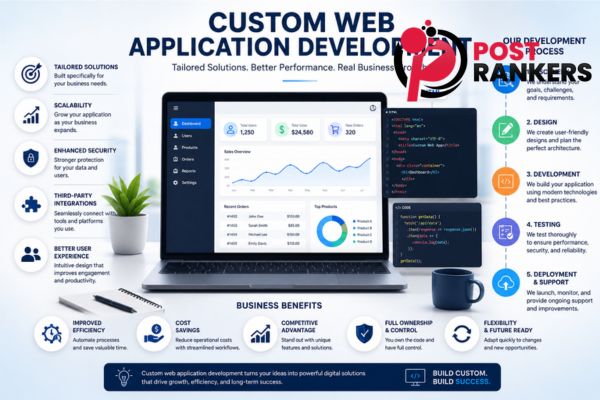
The Custom Web Application Development Process
Discovery and Planning
Successful projects begin with a thorough understanding of business goals. During the discovery phase, developers meet with stakeholders to identify requirements, define objectives, and determine project scope.
This stage lays the foundation for the entire development process. Therefore, careful planning helps minimize misunderstandings and ensures the final product aligns with expectations.
Design and User Experience
Once requirements are established, designers create wireframes and prototypes that outline the application’s structure and functionality. These visual representations allow stakeholders to review the user experience before development begins.
A thoughtful design process helps create intuitive interfaces that improve usability and encourage user engagement. As a result, businesses can deliver a better experience to both employees and customers.
Development and Testing
After design approval, developers begin building the application. They create front-end components, develop back-end functionality, and integrate necessary systems. Throughout development, teams conduct testing to identify and resolve issues before launch.
Testing plays a crucial role in ensuring quality. By evaluating functionality, security, and performance, developers can deliver a reliable application that meets business requirements.
Deployment and Maintenance
Launching a custom web application marks the beginning of its operational life. However, ongoing maintenance remains essential for long-term success. Businesses must regularly update software, address security concerns, and add new features as needs evolve.
Continuous support ensures the application remains effective and relevant in a changing digital environment.
Industries Benefiting from Custom Web Application Development
Healthcare
Healthcare organizations use custom applications to manage patient records, schedule appointments, and improve communication between providers and patients. These solutions help streamline operations while supporting regulatory compliance.
E-Commerce
Online retailers rely on custom web applications to create personalized shopping experiences, manage inventory, process payments, and track customer behavior. Consequently, businesses can improve conversion rates and customer satisfaction.
Education
Educational institutions utilize custom platforms for online learning, student management, course delivery, and communication. These systems help create more engaging and accessible learning experiences.
Finance
Financial organizations require secure applications for account management, transaction processing, reporting, and customer support. Custom solutions provide the flexibility and security necessary for handling sensitive financial data.
Emerging Trends in Custom Web Application Development
Artificial Intelligence Integration
Artificial intelligence is transforming the way web applications operate. Businesses increasingly use AI-powered chatbots, predictive analytics, and automation tools to improve efficiency and customer service.
Progressive Web Applications
Progressive Web Applications combine the accessibility of websites with the functionality of mobile apps. They offer fast performance, offline capabilities, and enhanced user experiences without requiring traditional app downloads.
Cloud-Based Architecture
Cloud technology allows businesses to scale resources efficiently while reducing infrastructure costs. As a result, many organizations are adopting cloud-native approaches when investing in custom web application development.
Advanced Data Analytics
Modern applications increasingly incorporate analytics tools that provide real-time insights into customer behavior, operational performance, and business trends. These capabilities help organizations make data-driven decisions with greater confidence.
How to Choose the Right Development Partner
Selecting the right development team can significantly impact project success. Businesses should evaluate experience, technical expertise, communication skills, and industry knowledge before making a decision.
A strong development partner takes the time to understand business objectives and provides strategic guidance throughout the project. Furthermore, ongoing support and transparent communication contribute to a more successful long-term relationship.
Conclusion
Custom web application development provides businesses with the opportunity to build technology that aligns perfectly with their goals, processes, and growth strategies. Unlike generic software, custom solutions offer greater flexibility, scalability, and control, allowing organizations to adapt quickly to changing market demands.
As digital transformation continues to reshape industries, businesses that invest in tailored web applications gain a significant competitive advantage. From improving efficiency and security to enhancing customer experiences, custom web application development remains one of the most effective ways to create sustainable business value in the modern digital era.
