

Ask someone outside the United States to describe American food and you’ll likely get a short list: hamburgers, hot dogs, maybe fried chicken, probably something involving cheese in quantities that would alarm a cardiologist. That answer isn’t wrong — those dishes are genuinely American, genuinely beloved, and genuinely delicious. But it misses almost everything interesting about what American food actually is and how it actually works. The truth is that American cuisine is one of the most diverse, dynamic, and culturally layered food traditions on the planet — a living, evolving record of every group of people who ever arrived on these shores, cooked what they knew, and left something permanent behind. That story is worth telling properly.
The Foundation: What Makes Food “American”
A Cuisine Built by Everyone Who Came
American food didn’t spring from a single culinary tradition the way French cuisine or Japanese cuisine did. It emerged from collision — the ongoing, centuries-long collision of Indigenous cooking traditions, European colonial foodways, African culinary knowledge brought over through the horrific machinery of slavery, and wave after wave of immigrant communities who arrived with their own ingredients, techniques, and flavors. Every group left an imprint. None of it was simple. All of it contributed something irreplaceable to what American food looks like today.
Native Americans provided the foundational ingredients that anchor the entire tradition: corn, beans, squash, wild rice, maple syrup, cranberries, pecans, and game meat formed the agricultural and foraging base from which everything else grew. Without corn alone — ground into cornmeal, fermented into hominy, roasted on the cob, or refined into the syrup that sweetens half the processed food on American grocery store shelves — American cuisine as we know it simply would not exist. That Indigenous agricultural legacy underpins the entire tradition, and it deserves recognition that mainstream food culture has historically failed to provide.
The African Contribution: Soul Food as American Food
One of the most significant and most underacknowledged chapters in American food history is the contribution of enslaved Africans and their descendants to the Southern cooking tradition that many people consider the emotional heart of American cuisine. Fried chicken, collard greens, black-eyed peas, okra, sweet potato pie, cornbread, rice dishes — these foods were shaped primarily by African hands, African techniques, and African flavor sensibilities that survived the Middle Passage and found expression in the kitchens of the American South. Soul food is not a regional curiosity. It is a foundational chapter of American culinary history, and its influence extends into virtually every corner of the national food culture.
Regional American Food: A Country of Many Tables
New England: Seafood, Simplicity, and Maple Everything
American food changes dramatically as you move across the country, and nowhere is that regional specificity more pronounced than in New England. The northeastern coastal tradition centers on what the Atlantic Ocean provides — clam chowder, lobster rolls, oysters, steamers, and fish prepared with the straightforward confidence of communities that have been eating them for generations. New England clam chowder — creamy, potato-filled, laden with clams — is one of the most recognized regional dishes in the entire country, and its reputation is entirely deserved. Meanwhile, maple syrup production in Vermont and New Hampshire gives the region a sweetener that appears in everything from breakfast tables to craft cocktail menus across the country.
The American South: Where Comfort Food Was Born
If American food has a spiritual home, most food writers and culinary historians would argue it lives somewhere in the American South. Southern cooking is the tradition that gave the world fried chicken, buttermilk biscuits, red-eye gravy, shrimp and grits, gumbo, jambalaya, pulled pork barbecue, peach cobbler, and banana pudding — a roster of dishes that reads like the definitive comfort food hall of fame. The technique of slow cooking tough cuts of meat over low heat for extended periods — the foundation of American barbecue — originated in the South and has since become one of the most globally recognized and imitated cooking methods in existence.
Furthermore, Southern food’s internal diversity is remarkable. Louisiana Creole cooking, shaped by French, Spanish, African, and Indigenous influences, produces dishes like gumbo and étouffée that bear no resemblance to the Appalachian tradition of beans and cornbread a few hundred miles north. Texas barbecue operates on completely different principles than Carolina barbecue, which itself differs fundamentally from Memphis-style preparation. The American South is not one food culture — it is many, layered and overlapping in ways that reward genuine exploration.
The Southwest: Heat, Heritage, and Tex-Mex Innovation
Southwestern American food is the product of centuries of cultural convergence between Indigenous, Mexican, and American cowboy traditions. The result is a cuisine built around heat, earth, and bold layering of flavor — dried and fresh chiles in varieties that range from mild and fruity to searingly hot, mesquite-grilled meats, tamales wrapped in corn husks, handmade tortillas, and beans prepared with the patience and care that transforms a simple ingredient into something genuinely transcendent.
Tex-Mex — the hybrid cuisine that blends Texas ranch cooking with Mexican culinary traditions — represents one of American food’s most successful and globally exported innovations. Dishes like fajitas, nachos, chile con queso, and the Tex-Mex style burrito were born at the intersection of two culinary cultures and have since traveled far beyond either of their points of origin. Today, Tex-Mex restaurants exist in virtually every major city worldwide, a testament to the appeal of a cuisine built on bold flavors, generous portions, and a spirit of creative improvisation.
The West Coast: Innovation, Health, and Multicultural Fusion
California and the broader West Coast have functioned as the laboratory of American food innovation for the past half century. The farm-to-table movement — the philosophy of building menus around locally sourced, seasonally appropriate ingredients — originated in California and has since reshaped restaurant culture across the entire country. The state’s extraordinary agricultural productivity, producing a significant share of the nation’s fruits, vegetables, and nuts, gives its chefs access to ingredients of a quality and variety unavailable anywhere else in the country.
Additionally, the West Coast’s demographic diversity — particularly the large Asian American communities in cities like Los Angeles, San Francisco, and Seattle — has produced some of the most creative and genuinely delicious fusion cooking in the world. Korean BBQ, Vietnamese pho, Japanese ramen, Filipino adobo, and Chinese dim sum have all been absorbed into the West Coast food culture with enough depth and authenticity to develop their own local variations. The result is a food scene that simultaneously honors immigrant traditions and generates genuinely new culinary ideas from their intersection.
Iconic American Food: The Dishes That Defined a Nation
The Classics That Built the Reputation
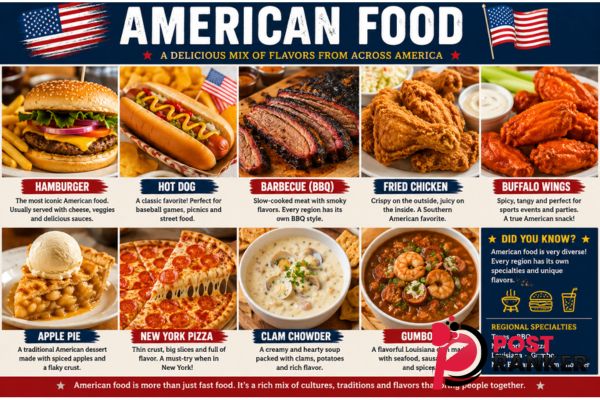
Certain American food items have achieved a global recognition that transcends cuisine and enters the territory of cultural symbol. The hamburger — ground beef patty on a bun, dressed with lettuce, tomato, onion, and condiments to personal preference — is arguably the most recognized food item on earth. It arrived with German immigrants, evolved through American fast food culture, and became the universally understood shorthand for American eating. Hot dogs at baseball games, apple pie at Thanksgiving, turkey at the center of the table — these are not just foods. They are rituals, and rituals carry meaning that mere nutrition cannot account for.
Fried chicken deserves its own moment of recognition. Whether served at a church picnic in Georgia, a fast food chain in Ohio, or a trendy restaurant in Brooklyn serving it with hot honey and pickles on a brioche bun, fried chicken functions as one of the few genuinely cross-cultural American food items — beloved across regional, racial, and class lines in ways that few other dishes manage. Its crispy exterior, juicy interior, and the particular satisfaction of eating it with your hands connect to something fundamental about pleasure and communality that sophisticated cuisine rarely achieves.
Barbecue: America’s Most Argued-About Food
No discussion of American food generates more passionate disagreement than barbecue. The debate isn’t really about whether barbecue is good — everyone agrees it’s good. The debate is about what barbecue actually is, and the answer depends entirely on where you’re asking. In Texas, barbecue means brisket — beef, smoked low and slow over oak for twelve to eighteen hours until the exterior develops a black bark and the interior yields with the gentleness of well-cooked meat at its absolute best. In the Carolinas, barbecue means pork — whole hog or shoulder — pulled apart and dressed with a vinegar-based sauce that cuts through the fat with bright acidity. In Kansas City, it means ribs and a thick, sweet, tomato-based sauce that caramelizes on the grill. Each tradition is deeply local, fiercely defended, and genuinely excellent. Together, they represent the breadth of what American food can mean within a single cooking method.
The Sweet Side of American Food
American dessert culture is both underrated and underanalyzed in most international discussions of the food tradition. Apple pie — the dish so associated with American identity that the phrase “as American as apple pie” became a cliché — arrived via European baking traditions but developed its distinctly American character through the abundance of domestically grown apples and the particular cultural weight the dish acquired over generations. Pecan pie, a Southern specialty built around the native pecan nut and sweetened with corn syrup and brown sugar, is one of the most intensely flavored and satisfying desserts in the American repertoire. New York cheesecake, key lime pie from Florida, Boston cream pie, Mississippi mud cake — the American dessert landscape reflects the same regional diversity and immigrant influence that defines every other dimension of the national food culture.
American Food in 2025: Where the Tradition Stands Now
Heritage Cooking Meets Modern Technique
American food in 2025 is experiencing one of the most interesting moments in its history. There is a powerful return to heritage cooking — a genuine desire among chefs, home cooks, and food writers to understand where American dishes actually came from, to credit the communities that created them, and to prepare them with the care and respect they deserve. Simultaneously, modern culinary technique, new ingredient availability, and the creative energy of an increasingly diverse national food culture are producing innovations that would be unrecognizable to any previous generation of American eaters.
Kimchi tacos, paneer burgers, jerk ramen, Japanese-American fusion sushi burritos — these dishes reflect an American food culture that has always been most creative and most alive at the moments when different traditions meet and generate something neither could have produced alone. That collision, which began the moment the first European ships arrived on American shores, has not stopped. It accelerates every decade as new communities arrive, establish roots, and contribute their culinary knowledge to a tradition that is always, fundamentally, a work in progress.
The Rise of Plant-Based and Ethical Eating
The contemporary American food landscape has been reshaped significantly by a growing emphasis on plant-based eating, ethical sourcing, and environmental sustainability. Plant-based versions of classic American dishes — the Impossible Burger, vegan fried chicken, oat milk-based mac and cheese — have moved from health food store novelty to mainstream grocery store staple with remarkable speed. Farm-to-table dining, once a premium niche, has become a baseline expectation at mid-range and above restaurants across the country. Consumers increasingly want to know where their food comes from, how the animals were raised, and what the environmental cost of their meal looks like — a set of concerns that is reshaping how American food is grown, sourced, prepared, and marketed.
Furthermore, the food truck movement — which exploded in American cities during the 2010s and has continued growing since — has democratized access to exceptional, chef-driven food while giving immigrant communities and first-generation American chefs a lower-barrier entry point into the professional food world. The halal cart, the taco truck, the Korean BBQ truck, the Vietnamese banh mi stand — these mobile operations have contributed as much to the evolution of American food culture as any Michelin-starred restaurant, and they do it at price points that make exceptional eating genuinely accessible.
American food, at its best, has always been the most honest possible expression of the country itself — complicated, contradictory, occasionally overwhelming, but fundamentally generous and endlessly creative. It absorbs influence from everywhere, transforms it into something distinctly its own, and then exports the result back to the world. That cycle has been running for centuries. It shows absolutely no signs of stopping.
