

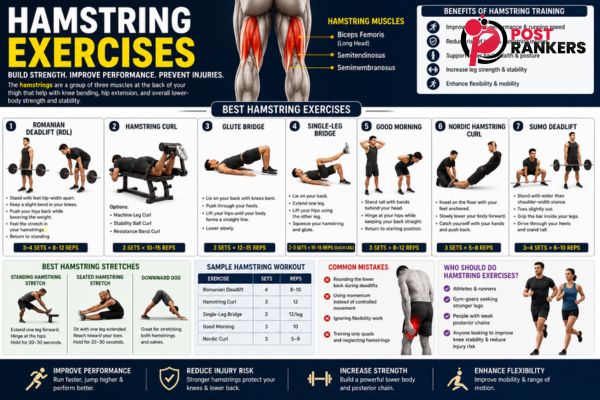
If you’ve ever pulled a hamstring sprinting for a bus or felt that nagging tightness after a long day at a desk, you already know these muscles deserve more attention than they usually get. Hamstring exercises aren’t just for athletes chasing speed on the track. They matter for anyone who wants to walk, run, squat, or bend without their lower body staging a quiet rebellion. Yet the hamstrings remain one of the most neglected muscle groups in the average workout routine, overshadowed by quads, glutes, and abs that get all the spotlight.
That oversight comes with a cost. Weak or tight hamstrings contribute to poor posture, lower back pain, and a higher risk of injury during everyday movements, not just intense workouts. The good news is that fixing this doesn’t require a complicated plan. A handful of well-chosen hamstring exercises, done consistently, can transform how your legs feel and perform.
Why Hamstring Exercises Deserve a Permanent Spot in Your Routine
The hamstrings are a group of three muscles running along the back of your thigh, and they do far more than bend your knee. They help extend your hip, stabilize your pelvis, and control deceleration when you’re running or changing direction. Because they cross two joints, they’re uniquely vulnerable to strain, especially when undertrained relative to the quadriceps in front.
This imbalance is incredibly common. Most people spend years squatting, lunging, and pressing without ever directly training the back of the thigh, which creates a strength gap that the body eventually notices. Over time, that gap shows up as tightness, reduced hip mobility, or a strain that seems to come out of nowhere. Targeted hamstring exercises close that gap before it becomes a problem.
The Connection Between Hamstrings and Lower Back Health
Here’s something that surprises a lot of people: weak hamstrings often masquerade as lower back pain. Because the hamstrings help stabilize the pelvis, when they’re underdeveloped, the lower back compensates by taking on extra load during everyday bending and lifting. Strengthening the hamstrings can therefore ease chronic back discomfort that stretching alone never quite fixes.
This is why physical therapists frequently include hamstring work in rehab programs for back pain, even when the hamstrings themselves aren’t injured. The posterior chain, which includes the glutes, hamstrings, and lower back, functions as a team. Strengthening one part without the others leaves the whole system vulnerable.
The Best Hamstring Exercises for Every Fitness Level
Building hamstring strength doesn’t require a gym membership or fancy equipment, though both can certainly help. What matters most is choosing movements that train the muscle through its full range, from hip-hinge patterns to knee-flexion work, since each targets the hamstrings slightly differently.
Bodyweight and At-Home Hamstring Exercises
For anyone starting out or working with minimal equipment, bodyweight options are an excellent entry point. Glute bridges are a great place to begin, as they activate the hamstrings and glutes simultaneously while teaching proper hip extension. Lie on your back, plant your feet, and drive your hips upward through your heels rather than your toes.
Single-leg Romanian deadlifts take things a step further by adding a balance challenge. Standing on one leg, hinge forward at the hips while keeping your back flat, then return to standing. This move builds strength while also exposing and correcting any side-to-side imbalances, which many people don’t even realize they have until they try it.
For something more advanced, Nordic hamstring curls are widely considered one of the most effective moves for preventing hamstring strains. Kneeling with your ankles anchored, you slowly lower your torso toward the ground, resisting the entire way down. It’s humbling at first, but research consistently links this exercise to fewer injuries.
Gym-Based and Equipment-Assisted Options
Once you have gym access, several tools make hamstring training more efficient. The leg curl machine, seated or lying, isolates the hamstrings directly and is useful for building size and fixing strength imbalances between legs. Because it removes other muscles from the equation, it’s also a smart choice for beginners learning to feel the muscle work.
Romanian deadlifts (RDLs) with a barbell or dumbbells remain a gold-standard movement for the entire posterior chain. The key is keeping a slight bend in the knees while hinging at the hips, allowing you to feel a deep stretch through the hamstrings before driving back to standing. Done correctly, RDLs build both strength and flexibility at once.
Kettlebell swings bring an element of power and speed that slower lifts don’t offer. This explosive hip-hinge movement trains the hamstrings to fire quickly, which translates directly into better performance for running, jumping, and other athletic movements, while also delivering a strong cardiovascular benefit.
How to Structure a Hamstring Workout for Real Results
Knowing the exercises is only half the battle; structuring them properly is where actual progress happens. Hamstrings respond best to a mix of hip-dominant movements, like deadlifts and swings, and knee-dominant movements, like leg curls and Nordic curls. Skipping one category in favor of the other leaves gaps in strength and increases injury risk down the road.
Sets, Reps, and Frequency
For general strength and muscle growth, aim for two to three hamstring-focused sessions per week, with eight to twelve reps per set across three or four sets. If your goal leans toward raw strength, dropping to four to six reps with heavier loads works well, though it demands more recovery between sessions.
Importantly, hamstrings need adequate rest to repair and grow, so back-to-back high-intensity sessions without recovery days tend to backfire. Spacing workouts with at least one rest day in between allows the muscle fibers to rebuild stronger, rather than accumulating fatigue that eventually leads to a strain.
Warming Up Properly Before Hamstring Work
Because the hamstrings are prone to injury, especially during explosive or eccentric-heavy movements, a proper warm-up isn’t optional. Start with five to ten minutes of light cardio, followed by dynamic stretches like leg swings or walking lunges. This primes the muscle for the demands ahead and lowers your risk of strain.
Skipping this step is a common mistake, particularly when time feels tight. Yet the few extra minutes spent warming up pale in comparison to the weeks of recovery required after a hamstring tear, making this step well worth the investment.
Common Mistakes That Sabotage Hamstring Training
Even well-intentioned lifters fall into patterns that limit results or raise injury risk. One frequent issue is rounding the lower back during deadlifts or RDLs, which shifts stress away from the hamstrings and onto the spine. Keeping a neutral spine throughout ensures the hamstrings, not the lower back, absorb the load.
Another common mistake is neglecting the eccentric, or lowering, portion of each rep. Since hamstring injuries often occur during the eccentric phase of movement, like the deceleration part of a sprint, training that phase deliberately through slow, controlled lowering builds resilience exactly where it’s needed most.
Ignoring Mobility Alongside Strength
Strength training alone isn’t enough if the hamstrings remain chronically tight. Pairing strength work with regular stretching, such as standing toe touches or seated forward folds, helps maintain full range of motion. Tight, strong hamstrings are still at risk; flexible, strong hamstrings are far more resilient.
Bringing It All Together
Hamstring exercises aren’t a niche addition for athletes alone; they’re foundational to how your entire lower body moves and feels. By combining hip-dominant and knee-dominant movements, training both strength and mobility, and respecting recovery time, you set yourself up for fewer injuries and better performance across every activity that matters to you. Start with two focused sessions a week, prioritize good form over heavy weight, and the results will follow.
