

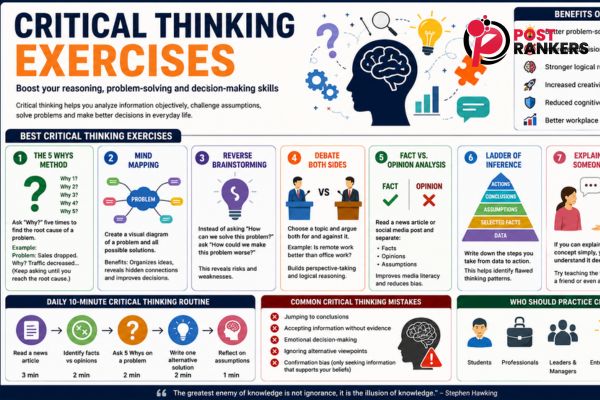
Most people assume critical thinking is something you either have or don’t, like perfect pitch or a natural sense of direction. That assumption is wrong, and it’s costing people better decisions every single day. Critical thinking exercises work the same way physical training works for muscles: the more deliberately you practice, the stronger and more automatic the skill becomes. This isn’t about becoming a philosopher or memorizing logic textbooks.
It’s about training your brain to pause before reacting, question assumptions before accepting them, and weigh evidence before forming an opinion. In a world flooded with misinformation, persuasive marketing, and snap judgments dressed up as facts, that pause matters more than ever. The exercises below aren’t abstract theory; they’re practical tools you can start using today to think more clearly, argue more effectively, and make decisions you won’t regret.
Why Critical Thinking Exercises Matter More Than Ever
Information moves faster than our ability to evaluate it, and that gap is exactly where bad decisions live. Headlines are designed to trigger emotion before logic kicks in, and social media algorithms reward outrage over accuracy. Without deliberate practice, the brain defaults to mental shortcuts that feel efficient but often lead us astray.
These shortcuts, known as cognitive biases, aren’t a sign of weak intelligence. Even brilliant people fall victim to confirmation bias, anchoring, and groupthink because these patterns are baked into how the brain conserves energy. Critical thinking exercises interrupt that autopilot mode, forcing the brain to slow down and examine what it would otherwise accept without question.
The Difference Between Knowledge and Thinking
It’s worth separating two things people often confuse: knowing a lot of facts and actually thinking well. Someone can memorize an encyclopedia’s worth of information and still make poor decisions if they can’t evaluate, connect, or question that information effectively. Critical thinking is the skill that turns raw knowledge into sound judgment.
This distinction matters because traditional education tends to emphasize memorization over reasoning. As a result, many adults reach the workplace without ever having been taught how to systematically question a claim or weigh competing evidence. Critical thinking exercises fill that gap, regardless of how much formal schooling someone has completed.
Logic-Based Critical Thinking Exercises to Build Mental Sharpness
Logic puzzles and structured reasoning drills are some of the most direct ways to train analytical thinking. They force the brain to follow a chain of evidence to a conclusion, rather than jumping straight to an answer based on gut feeling. Over time, this builds a habit of methodical thinking that carries over into real-world decisions.
Brain Teasers and Lateral Thinking Puzzles
Lateral thinking puzzles present a strange scenario and ask you to figure out what happened, often requiring you to question assumptions baked into the setup. Unlike straightforward riddles, these puzzles reward people who can look at a problem from unconventional angles rather than forcing it into a familiar pattern. Practicing them regularly trains flexible, non-linear thinking.
Syllogism practice offers a more structured alternative, working through “if A, then B” style logical statements to test whether conclusions actually follow from their premises. This exercise is particularly useful for spotting flawed reasoning in arguments, advertisements, or political rhetoric, where conclusions are often presented as obvious when they’re anything but.
The Five Whys Technique
Originally developed for root-cause analysis in manufacturing, the Five Whys technique has become a favorite critical thinking exercise far beyond the factory floor. The method is simple: take a problem and ask “why” five times in a row, with each answer prompting the next question. By the fifth why, you’ve usually moved past surface symptoms into the actual underlying cause.
This exercise works particularly well for personal decision-making, too. If you keep missing deadlines, for example, asking why repeatedly might reveal that the real issue isn’t time management but rather a fear of starting imperfect work. Surface-level fixes rarely solve problems rooted somewhere deeper.
Perspective-Shifting Exercises That Strengthen Reasoning
Critical thinking isn’t only about logic; it’s also about resisting the pull of your own biases long enough to consider other viewpoints fairly. These exercises deliberately push you outside your comfort zone, which is exactly why they’re so effective at exposing blind spots you didn’t know you had.
Devil’s Advocate Role-Play
One of the most uncomfortable but valuable critical thinking exercises involves arguing against your own position, even when you’re confident you’re right. This forces you to genuinely understand the strongest version of the opposing argument, rather than dismissing it with a weaker, easier-to-beat version. If you can’t argue the other side convincingly, you probably don’t understand your own position as well as you think.
This exercise works especially well in group settings, where one person is assigned to challenge every proposal, regardless of personal opinion. Teams that build this practice into meetings often catch flawed plans before they become expensive mistakes, since someone is always actively hunting for weaknesses.
Six Thinking Hats Method
Developed by Edward de Bono, the Six Thinking Hats method assigns six different “hats,” each representing a distinct way of approaching a problem: facts, emotions, risks, benefits, creativity, and process. Working through a decision while deliberately wearing each hat ensures you don’t settle into one mode of thinking and miss an entire dimension of the problem.
For instance, a purely optimistic thinker might overlook risks entirely, while an overly cautious one might kill good ideas before they’re explored. Cycling through all six perspectives, even briefly, produces a more balanced and well-rounded conclusion than relying on a single instinctive reaction.
Everyday Habits That Reinforce Critical Thinking Exercises
Formal exercises matter, but critical thinking sticks best when it becomes a daily habit rather than an occasional drill. Small, consistent practices compound over time, gradually reshaping how you process information without requiring dedicated study sessions.
Journaling Your Decisions
Writing down the reasoning behind a decision, then reviewing it weeks later, is a surprisingly powerful critical thinking exercise. It reveals patterns in your thinking, including biases you didn’t notice in the moment, since hindsight often exposes flawed assumptions that felt completely reasonable at the time. Over months, this habit sharpens self-awareness considerably.
Questioning Assumptions Daily
Make it a habit to ask “how do I know this is true?” about beliefs you’ve never actually examined. Many opinions are inherited from family, media, or culture without ever being independently verified, and gently interrogating them on a regular basis prevents intellectual stagnation. This single habit, practiced consistently, does more for critical thinking than any single workshop or course ever could.
Building a Sharper Mind, One Exercise at a Time
Critical thinking exercises aren’t a one-time fix; they’re an ongoing practice that compounds with consistency. Whether you start with a daily logic puzzle, a weekly devil’s advocate discussion, or simply journaling your decisions, the goal remains the same: training your brain to pause, question, and reason rather than react. Start small, stay consistent, and you’ll notice sharper, more confident decision-making within weeks.
