

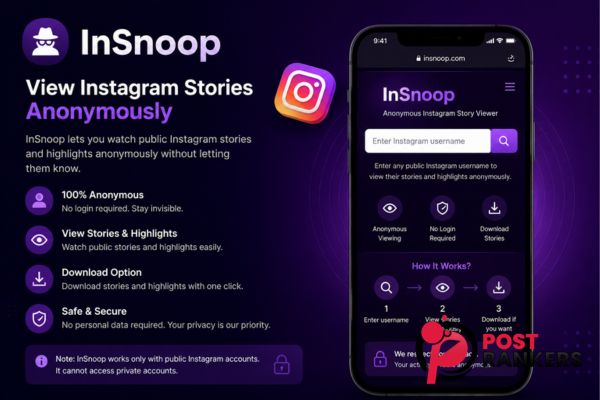
We’ve all been there. You want to check someone’s Instagram story — an ex, a competitor, a crush, a celebrity you follow casually — but you don’t want them to know you looked. It feels like a small thing, but Instagram’s built-in viewer list makes it anything but private. The moment you tap that story, your name goes on the list. There’s no taking it back. That reality has quietly driven millions of users toward third-party tools that promise anonymous viewing — and InSnoop is consistently one of the first names that comes up. But what exactly is InSnoop? How does it actually work? And more importantly, is it safe, legal, and worth your time? Let’s cut through the noise and give you a real answer.
What Is InSnoop?
InSnoop is a free, browser-based web tool designed to let users view and download public Instagram stories and highlights without logging into their Instagram account or appearing on the story’s viewer list. You don’t install an app. You don’t create an account. You simply visit the InSnoop website, type in a public Instagram username or paste a profile link, and the tool retrieves the available stories for you to watch — completely anonymously, at least in theory.
The concept is straightforward, and the appeal is obvious. Instagram’s native experience is built around visibility and engagement. Every view is tracked, every interaction is recorded, and the algorithm uses all of that data constantly. InSnoop positions itself as an escape hatch from that system — a way to consume public content without feeding your identity into someone else’s analytics or tipping off the person whose story you’re watching. For a certain type of user, that proposition is genuinely valuable.
Who Actually Uses InSnoop?
The user base for InSnoop is more diverse than you might expect. It’s not just curious people checking up on former partners — though that’s certainly part of it. Marketers and brand strategists use anonymous story viewers to monitor competitor content, track influencer trends, and gather campaign inspiration without revealing which brands are keeping tabs on whom. Journalists and researchers use it to document public content without the account owner knowing they’re being observed. Social media managers use it to review client competitors discreetly. And yes, plenty of ordinary users simply want to stay current on someone’s content without triggering a social interaction they’re not ready for.
The point is that anonymous viewing isn’t inherently suspicious or wrong. Sometimes you just want to watch without starting a conversation, and InSnoop fills that specific gap in a way the official Instagram platform deliberately does not.
How InSnoop Actually Works
The Proxy Model Explained Simply
Understanding InSnoop’s mechanics doesn’t require a computer science degree. The tool operates as a proxy — a middleman layer that sits between you and Instagram’s servers. When you enter a username into InSnoop’s search bar, InSnoop’s own servers send the request to Instagram on your behalf. Instagram sees a request from InSnoop’s infrastructure, not from your personal account or IP address. The stories get retrieved and displayed through InSnoop’s interface. You watch the content. Your name never gets logged as a viewer because you never technically accessed Instagram directly.
Think of it the way one tech writer described it — like a window with open curtains. If the account is public, you can see inside from InSnoop’s window. If the curtains are closed — meaning the account is private — InSnoop sees nothing, and neither do you. The tool has no ability to access private accounts under any circumstances, which is an important limitation to understand upfront.
What InSnoop Can and Cannot Do
InSnoop can retrieve stories and highlights from public Instagram accounts. It can display them in a clean, distraction-free interface without the clutter of the standard Instagram layout. It can show you the timestamp of when a story was uploaded. And in most cases, it allows you to download stories as photos or videos directly to your device. Furthermore, it works across all devices — desktop browsers, Android smartphones, iPhones, and tablets — without any software installation or account registration required.
What InSnoop cannot do is equally important. It cannot access private accounts. It cannot guarantee consistent performance — users regularly report stories failing to load, profiles not appearing after the story ring shows, or the tool going offline entirely. It does not offer analytics, scheduling, or any advanced social media features. And critically, it cannot guarantee your complete anonymity in the way its marketing suggests. That last point deserves a much closer look.
The Honest Conversation About Safety and Privacy
Is InSnoop Actually Safe to Use?
This is where things get more complicated than the tool’s simple interface would suggest. InSnoop markets itself as a privacy-protecting tool, which creates a somewhat ironic situation: to protect your privacy from Instagram, you’re entrusting your browsing activity to a third-party platform with no verified privacy policy and very limited transparency about who runs it, how it stores data, or what it does with the information it collects.
Here’s what that means in practice. When you use InSnoop, your IP address, browsing history, and device fingerprint can potentially be recorded by the tool itself. There is no verified data retention policy. There is no official customer support. There is no transparent ownership structure. The company behind InSnoop has not published information about its team, its legal entity, or its operational infrastructure. That doesn’t automatically make it malicious — but it does mean you’re operating without the consumer protections you’d normally expect from a legitimate software product.
The Risk You’re Actually Taking
The practical risk for most casual users is relatively low. InSnoop is not known to have stolen Instagram credentials or engaged in obviously fraudulent behavior. Because the tool doesn’t require you to log in with your Instagram account, your actual Instagram login information is never at risk. The more realistic concern is data collection — the possibility that InSnoop logs your search history, the usernames you’ve looked up, and your device information, and uses or sells that data in ways you’d find uncomfortable if you knew about it. For users simply checking a public figure’s story occasionally, the risk profile is minimal. For users conducting sensitive research or regularly viewing specific individuals’ content, it’s worth thinking more carefully.
Is InSnoop Legal?
The legal question is one that genuinely confuses people, so let’s address it directly. Viewing publicly available content online is generally legal. Public Instagram accounts are, by definition, accessible to anyone — that’s the entire point of making an account public. InSnoop accesses only that public content, which means it doesn’t technically “hack” anything or breach any system. From a pure legality standpoint, casual use of InSnoop is unlikely to create any legal exposure for the average user.
However — and this is a meaningful however — InSnoop almost certainly violates Instagram’s Terms of Service. Instagram’s platform rules generally prohibit scraping, automated access, and the use of unauthorized third-party tools to retrieve content. Instagram is owned by Meta, and Meta actively works to identify and block tools that access its data through unauthorized means. This creates an ongoing cat-and-mouse situation where InSnoop and similar tools frequently experience outages or functionality failures as Instagram updates its systems to block them.
Breaking Instagram’s terms of service is not the same as breaking the law. But it does mean the tool’s functionality is perpetually uncertain, and it does mean that Instagram could restrict or block InSnoop’s access at any point without warning. That instability is a real limitation worth factoring into your decision about using it.
InSnoop Compared to Alternatives
How It Stacks Up in a Crowded Field
InSnoop is far from the only anonymous Instagram story viewer on the market. Tools like StoriesIG, IgAnony, and StealthGram operate on similar proxy-based principles and offer comparable core functionality. The differences between them come down to design quality, loading speed, reliability, and occasional extra features. Some competing tools have more transparent ownership structures or more consistent uptime. Others are faster or offer cleaner download interfaces.
InSnoop’s particular appeal lies in its simplicity. The interface is clean, beginner-friendly, and genuinely easy to navigate on any device. For users who just want to get in, watch a story, and get out without complications, that simplicity is a genuine advantage. For users who want a more robust, reliable, or feature-rich experience, exploring alternatives may be worthwhile.
When InSnoop Makes Sense — and When It Doesn’t
InSnoop makes the most sense for occasional, casual anonymous viewing of public Instagram content. If you’re a marketer doing a quick competitive check, a journalist documenting a public figure’s story, or simply someone who wants to watch content without triggering a social signal, InSnoop handles that use case adequately and without requiring any setup investment.
It makes less sense as a long-term, reliable tool for anything professionally or personally significant. Its reliability is inconsistent. Its privacy protections are unverified. And because it operates in Instagram’s policy gray area, there’s no guarantee it will be functional a month from now. For anything that requires consistent, trustworthy performance, the official Instagram platform or professionally supported social media monitoring tools remain the more stable choice.
The Bigger Picture: Privacy, Ethics, and Digital Awareness
InSnoop exists because Instagram built a surveillance mechanism — the viewer list — directly into a feature that people use casually and constantly. The desire to watch content without being logged is entirely human and, in most cases, entirely harmless. InSnoop and tools like it are direct responses to a gap that Instagram has deliberately left open, and their popularity reflects genuine user demand for more control over their own digital footprint.
That said, using any third-party tool requires informed decision-making. Understanding what InSnoop can do, what it can’t do, where its risks lie, and what alternatives exist puts you in a position to make a choice that actually matches your needs and comfort level. Anonymous viewing isn’t inherently problematic — but anonymous tools built without transparency deserve scrutiny. Use this for what it does well, go in with clear eyes about its limitations, and you’ll get exactly what you came for without any unpleasant surprises.
