

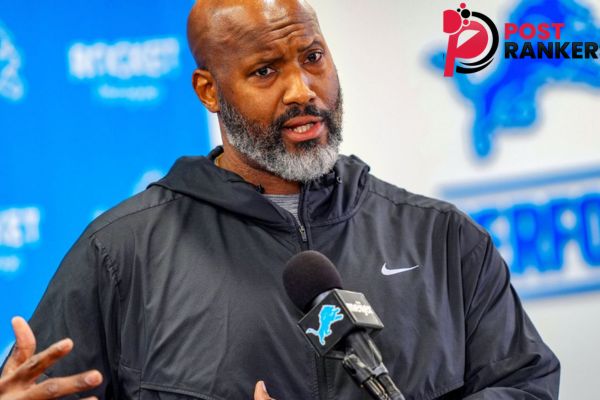
There are general managers who inherit good teams and look smart. There are general managers who spend enormous sums in free agency and produce results that roughly match their spending. And then there are general managers who walk into one of professional football’s most historically troubled franchises, rebuild it from the foundation up through draft intelligence and bold trades, and transform it into a team that an entire city — a city that had not celebrated a playoff victory since 1992 — genuinely believes can win a Super Bowl. Brad Holmes belongs to that third category. And the story of how he got there, from a public relations internship in St. Louis to back-to-back PFWA Executive of the Year awards in Detroit, is one of the most compelling career narratives in contemporary professional sports.
Who Is Brad Holmes?
Brad Holmes is the Executive Vice President and General Manager of the Detroit Lions of the National Football League — a position he has held since January 14, 2021. He was born on July 29, 1979, in Tampa, Florida, making him 45 years old as of 2025. He grew up in a football household — both his father and his uncle played in the NFL during the 1970s — and carried that athletic legacy into his own playing career as a defensive tackle at North Carolina A&T State University, a historically Black university in Greensboro, North Carolina, where he developed both his football knowledge and the professional values that define his leadership style today.
His path from player to one of the most respected front office executives in the NFL was not a straight line. It wound through a media internship with the NBA’s Atlanta Hawks, a pivotal job offer decision between two NFL franchises, eighteen seasons of meticulous talent evaluation work with the Los Angeles Rams organization, and finally the moment that changed everything — a phone call from Detroit that set him on course to reshape one of the league’s most storied and most frustrated franchises.
Brad Holmes’ Early Life and Family Background
Football in the Family from the Beginning
Brad Holmes did not discover football. He was born into it. His father played in the NFL during the 1970s, and his uncle did as well — a family athletic legacy that gave Holmes an intimate understanding of the professional game from childhood. He attended George D. Chamberlain High School in Tampa, Florida, where he played defensive tackle and developed into a collegiate-level prospect. That foundation — built on family football knowledge and competitive high school play — informed every subsequent decision in his career, from the positions he chose to scout most closely to the qualities he prioritized in building the Lions’ roster.
At North Carolina A&T, Holmes played defensive tackle at a Division I-AA level while pursuing the academic and professional development that would eventually redirect his ambitions from the field to the front office. His playing career gave him something that many purely administrative football executives never fully acquire: the visceral, inside-the-helmet understanding of what the game demands from the athletes who play it. That perspective — knowing from physical experience how football actually feels — shapes how the best talent evaluators do their work, and it has clearly shaped how Brad Holmes does his.
From the Hawks to the NFL: The Internship That Opened Everything
After his playing career ended, Brad Holmes pursued a media internship with the NBA’s Atlanta Hawks — a strategic move designed to build the industry connections he needed to enter professional sports administration. That internship worked precisely as intended. It gave Holmes exposure to professional sports organizational culture and, more importantly, the professional network that produced his first NFL opportunity. By 2003, he had job offers from two NFL franchises: the Detroit Lions and the St. Louis Rams. He chose the Rams. That decision — which he has recounted publicly with a mixture of appreciation for the Rams’ development culture and the irony of eventually ending up in Detroit anyway — launched an eighteen-year apprenticeship that produced one of the most thoroughly prepared general managers in the league’s recent history.
Brad Holmes’ Career: Eighteen Years in the Making
Building a Foundation with the Rams
Brad Holmes joined the St. Louis Rams organization in 2003 as a scout — the entry-level position in NFL talent evaluation that requires years of film study, college campus visits, player interviews, and the slow accumulation of the judgment that distinguishes good talent evaluators from great ones. He spent a decade learning the craft at every level of the scouting hierarchy before the Rams elevated him to Director of College Scouting in 2013 — a promotion that placed him in charge of overseeing the team’s entire college talent evaluation operation for eight seasons.
Those eight seasons as Director of College Scouting coincided with one of the most successful rebuilding periods in Rams franchise history. The organization moved from St. Louis to Los Angeles, rebuilt its roster through the draft, acquired quarterback Jared Goff with the first overall pick in 2016, traded for wide receiver Brandin Cooks and corner Aqib Talib, and ultimately reached Super Bowl LIII following the 2018 season. Holmes’ fingerprints were on the college talent pipeline that supplied the roster throughout that run — a sustained contribution to organizational success that built his reputation across the league without generating the kind of personal publicity that coaches and general managers typically receive.
The Call from Detroit: A Franchise at Its Lowest
When the Detroit Lions parted ways with general manager Bob Quinn following the 2020 season, the franchise was in a difficult position by almost every measure. They had not made the playoffs since 2016. They had not won a playoff game since 1992 — a drought spanning nearly three decades that had made Lions fandom an exercise in sustained, recurring disappointment. Their roster needed significant renovation. Their culture needed rebuilding. And their front office needed a leader who understood both the patience required for a genuine rebuild and the boldness required to accelerate one.
Detroit’s front office, led by vice president of football operations Mike Disner and CEO Rod Wood, identified Holmes as their primary target. He interviewed, impressed the organization’s leadership, and was officially named Executive Vice President and General Manager on January 14, 2021. His mandate was straightforward and enormous: change everything.
The Stafford Trade: The Move That Rewrote the Lions’ Future
A Bold Decision Under Immediate Pressure
Brad Holmes had barely settled into his new role when the most consequential decision of his tenure arrived on his desk. Matthew Stafford — the Lions’ franchise quarterback for over a decade — made clear that he wanted to be traded to a contending team. For a general manager just weeks into the job, the pressure was extraordinary. Trading your starting quarterback without a clear replacement is the kind of move that defines careers in either direction, and Holmes made it with a clarity and swiftness that immediately announced what kind of decision-maker he was going to be.
He found his trade partner in his former employer — the Los Angeles Rams — who acquired Stafford and sent back a package that included multiple first-round draft picks and quarterback Jared Goff. That trade, assessed at the time with considerable skepticism in Detroit, became the most important transaction in Lions franchise history over the following three years. Goff, written off as a failed experiment in Los Angeles, thrived in the Lions’ offensive system and became one of the most efficient quarterbacks in the NFC. The acquired draft picks — used by Holmes with consistent intelligence across multiple drafts — built the young core that transformed Detroit from a losing franchise into a genuine playoff contender.
Draft Excellence: The Foundation of the Rebuild
The standard by which NFL general managers are ultimately judged is draft performance, and Brad Holmes’ draft record since arriving in Detroit is exceptional by any reasonable standard. His first draft class in 2021 produced offensive tackle Penei Sewell — who became an All-Pro and one of the best offensive linemen in the league — and wide receiver Amon-Ra St. Brown, who developed into one of the most productive and reliable pass catchers in the NFL. Both players were selected within the first four rounds and represent exactly the kind of high-value, long-term roster building that distinguishes elite general managers from average ones.
Subsequent draft classes added running back Jahmyr Gibbs and tight end Sam LaPorta — both of whom made immediate impacts as rookies — defensive end Aidan Hutchinson, linebacker Malcolm Rodriguez, and a series of depth contributors who gave the Lions the roster breadth required to sustain success across a full NFL season. Holmes has demonstrated the ability to identify talent at every level of the draft, convert compensatory picks into productive players, and build through the middle rounds in ways that create genuine value rather than simply filling roster spots.
The Jared Goff Renaissance
One of the most underappreciated aspects of Brad Holmes’ tenure in Detroit is what he did with Jared Goff. The conventional wisdom when Holmes acquired Goff as part of the Stafford trade was that he was a stopgap — a placeholder quarterback to manage the team while the draft picks accumulated into something better. Holmes never treated him that way. He built an offensive system around Goff’s strengths, surrounded him with weapons, and gave him the kind of institutional support that allows quarterbacks to play at their best. The result was a Goff renaissance that saw him play some of the finest football of his career in Detroit and become the unquestioned leader of a team that reached the NFC Championship Game — their deepest playoff run in decades.
Brad Holmes’ Leadership Philosophy
Collaborative by Design
One of the defining characteristics of Brad Holmes’ leadership style is his commitment to collaboration. He has built a front office culture that values input across levels — from senior scouts to analytics staff to coaching personnel — and consistently credits the people around him for the Lions’ success rather than positioning himself as the singular architect of the rebuild. That collaborative philosophy is not simply a PR posture. It is the structural principle around which he built his entire organization, and it has created the kind of internal alignment that allows good decision-making to happen consistently rather than occasionally.
His partnership with head coach Dan Campbell — who arrived in Detroit the week after Holmes was hired — represents one of the most effective GM-coach relationships in the current NFL. Both operate with a directness and authenticity that has shaped the Lions’ organizational culture from top to bottom and created a team identity built around accountability, toughness, and genuine camaraderie that players have consistently described as unlike any environment they have experienced elsewhere.
Creating Opportunity for the Next Generation
Brad Holmes is one of six Black general managers currently working in the NFL — a number that represents both meaningful progress from the sport’s historical homogeneity and a reminder of how much work remains in diversifying football’s front office leadership. Holmes takes that responsibility seriously and acts on it structurally rather than rhetorically. When he was hired in Detroit, he brought Ray Agnew and Mike Martin into prominent roles on his staff, deliberately building a front office that reflected the diversity he believed should characterize the sport’s leadership.
In 2024, he co-created the Wally Triplett Fellowship — a program designed to introduce minority college students to careers in professional football outside of playing and coaching. Triplett, the first Black player drafted and signed by an NFL team who then actually played, is an appropriate namesake for a program aimed at expanding access to the industry. Holmes has cited the mentorship he received from former general managers Ozzie Newsome and Jerry Reese — two of the rare Black executives to reach the GM level in previous generations — as formative in his own development, and the Fellowship represents his commitment to paying that mentorship forward systematically.
Brad Holmes’ Net Worth and Recognition
Based on estimates from sports industry sources, Brad Holmes’ net worth is approximately $10 to $15 million as of 2025, reflecting his compensation as one of the NFL’s most successful general managers — a category that commands salaries ranging from $3 million to $8 million annually at the top tier. His back-to-back PFWA Executive of the Year awards in 2023 and 2024 represent the formal recognition of a football industry that had been watching his work closely and reached a clear consensus about its quality.
NFL analyst Gregg Rosenthal captured the broader professional assessment well, writing that Holmes “has done virtually no wrong since arriving” in Detroit and noting the particular difficulty of sustaining a rebuild’s momentum beyond the initial exciting phase — a challenge that Holmes has met with the same methodical intelligence he brought to every previous stage of his career.
Why Brad Holmes’ Story Matters Beyond Football
The career of Brad Holmes matters beyond the wins and losses column and beyond the draft grades and free agency evaluations that dominate sports media coverage. It matters because it represents a model of how professional success is actually built — through sustained investment in craft, through the willingness to make bold decisions under pressure, through collaborative leadership rather than autocratic control, and through a commitment to expanding opportunity for others even while managing the daily demands of one of professional sports’ most scrutinized positions.
He started his NFL career as a public relations intern. He chose the Rams over the Lions in 2003 on instinct and circumstance. He spent eighteen years learning every dimension of talent evaluation before the Detroit Lions gave him the opportunity to apply everything he had learned. And then he applied it, comprehensively and consistently, transforming a franchise that had been synonymous with disappointment into one of the most exciting and promising teams in professional football. That story — earned, deliberate, and still unfolding — is exactly the kind of story that the NFL, and American sports more broadly, needs more of.
