

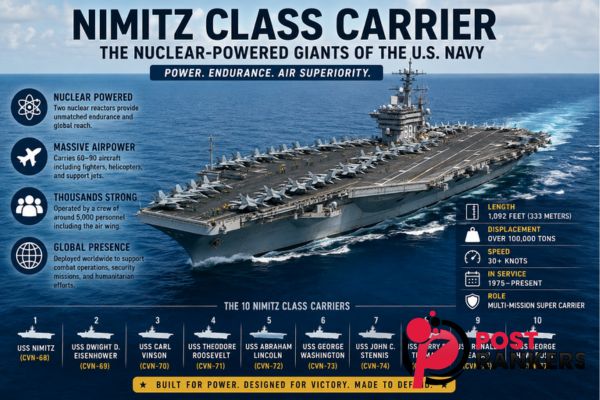
Understanding the Legacy of the Nimitz Class Carrier
The Nimitz class carrier stands as one of the most influential achievements in modern naval history. For decades, these massive nuclear-powered aircraft carriers have served as the backbone of the United States Navy, projecting military power across oceans and supporting operations around the globe. Their combination of size, endurance, and airpower transformed the way nations think about maritime dominance.
Since the first ship entered service in the 1970s, the Nimitz class carrier has become a symbol of American naval strength. These floating airbases can travel thousands of miles, launch advanced combat aircraft, and remain operational for extended periods without requiring conventional fuel. As a result, they continue to play a critical role in international security and military strategy.
The Origins of the Nimitz Class Carrier
A New Era of Naval Engineering
During the Cold War, military planners recognized the need for larger and more capable aircraft carriers. Existing vessels had proven effective, yet advances in aviation technology demanded bigger flight decks, greater storage capacity, and improved operational flexibility.
To meet these challenges, the United States Navy developed the Nimitz class carrier. Named after Fleet Admiral Chester W. Nimitz, a legendary commander during World War II, the class represented a major leap forward in naval engineering. Engineers designed these ships to support larger air wings while maintaining exceptional endurance through nuclear propulsion.
Building the First Supercarrier
The lead ship, USS Nimitz (CVN-68), entered service in 1975 and immediately demonstrated the advantages of its groundbreaking design. Unlike conventional carriers, it relied on nuclear reactors instead of traditional fuel systems. Consequently, the ship gained the ability to operate for years without refueling its propulsion system.
The success of the first vessel encouraged the Navy to expand the program. Over time, ten Nimitz-class carriers entered service, creating one of the most powerful carrier fleets ever assembled.
Design and Size of the Nimitz Class Carrier
Massive Dimensions
One of the most striking features of a Nimitz class carrier is its enormous size. These vessels stretch more than 1,000 feet in length and displace over 100,000 tons when fully loaded. Their flight decks cover several acres, providing enough space to launch and recover dozens of aircraft during continuous operations.
Despite their massive dimensions, these carriers remain highly maneuverable. Advanced propulsion systems and sophisticated navigation technology allow them to operate efficiently in a variety of maritime environments.
A Floating Military City
Life aboard a Nimitz class carrier resembles life in a small city. Thousands of sailors, pilots, maintenance personnel, medical staff, and support crews live and work on board. The ship contains sleeping quarters, dining facilities, medical centers, communication hubs, and recreational spaces.
Because deployments often last several months, the vessel must provide everything necessary to sustain its crew. Therefore, logistics and planning play a vital role in maintaining operational readiness during extended missions.
Nuclear Power: The Secret Behind Its Endurance
How Nuclear Propulsion Works
The defining feature of the Nimitz class carrier is its nuclear-powered propulsion system. Each vessel uses two nuclear reactors that generate enormous amounts of energy. This energy creates steam, which powers turbines connected to the ship’s propellers.
Unlike conventionally powered ships that require regular refueling, these reactors can operate for decades before needing replacement or major servicing. As a result, the carrier gains unmatched operational flexibility and global reach.
Strategic Advantages
Nuclear propulsion offers several important benefits. First, it allows the ship to travel long distances without relying on fuel supply vessels. Second, it frees up valuable storage space that would otherwise hold fuel, allowing more room for aircraft fuel, ammunition, and supplies.
Additionally, the ability to remain at sea for extended periods enhances military readiness. When global tensions rise, a Nimitz class carrier can respond quickly without worrying about immediate refueling requirements.
Air Power at Sea
The Carrier Air Wing
A Nimitz class carrier functions as a mobile airbase capable of carrying dozens of aircraft. Depending on mission requirements, the carrier can operate fighter jets, electronic warfare aircraft, airborne surveillance platforms, helicopters, and logistics aircraft.
This diverse air wing allows commanders to conduct a wide range of missions. Whether supporting combat operations, providing humanitarian assistance, or conducting reconnaissance, the carrier delivers significant operational flexibility.
Launching and Recovering Aircraft
The flight deck serves as the heart of carrier operations. Steam-powered catapults accelerate aircraft to takeoff speed within seconds, while arresting cables help safely recover returning planes. These systems enable continuous flight operations even in challenging conditions.
Moreover, highly trained deck crews coordinate every movement with precision. Their expertise ensures that aircraft launch and land efficiently while maintaining safety standards on one of the busiest workspaces in the military.
Combat Operations and Global Presence
Supporting Military Missions Worldwide
Throughout their service history, Nimitz-class carriers have participated in numerous military operations across different regions of the world. They have supported missions in the Middle East, the Pacific, Europe, and other strategic areas.
Because they can operate independently for long periods, these carriers often serve as the first military assets to arrive during crises. Their presence provides immediate airpower and demonstrates a nation’s commitment to regional stability.
Humanitarian and Disaster Relief Efforts
While combat operations often receive the most attention, Nimitz-class carriers also contribute to humanitarian missions. Following natural disasters, these ships can deliver medical support, transportation, communications, and emergency supplies.
Their ability to generate electricity, produce fresh water, and support helicopter operations makes them valuable assets during relief efforts. Consequently, they frequently assist communities affected by earthquakes, hurricanes, and other catastrophic events.
The Crew Behind the Mission
Thousands Working as One Team
Operating a Nimitz class carrier requires extraordinary teamwork. The ship’s crew includes personnel from a wide range of specialties, each contributing to mission success. Pilots, engineers, mechanics, medical professionals, and communication experts all play essential roles.
This collaborative environment creates a highly organized system capable of functioning around the clock. Every crew member understands the importance of their responsibilities, which helps maintain operational effectiveness during demanding deployments.
Training and Readiness
Crew members undergo extensive training before serving aboard a carrier. They must master technical skills, emergency procedures, and operational protocols. Furthermore, continuous drills ensure that personnel remain prepared for unexpected situations.
This commitment to readiness allows the carrier to perform effectively in both routine operations and high-pressure scenarios.
Challenges Facing the Nimitz Class Carrier
Aging Fleet Concerns
Although the Nimitz class carrier remains highly capable, many ships in the fleet have been operating for decades. Maintaining these vessels requires significant investment in modernization and maintenance programs.
Engineers continually upgrade systems to keep pace with evolving technology and emerging threats. Consequently, these carriers remain effective despite their age.
Evolving Naval Warfare
Modern warfare presents new challenges, including advanced missile systems, cyber threats, and unmanned technologies. Naval planners must adapt carrier operations to address these developments while preserving their strategic advantages.
Fortunately, the flexibility of the Nimitz-class design allows for upgrades and modifications that extend operational relevance well into the future.
The Transition to the Future
The Arrival of the Ford Class
The United States Navy has begun introducing the Gerald R. Ford-class carriers as the next generation of supercarriers. These vessels incorporate advanced technologies designed to improve efficiency and operational performance.
However, the Nimitz class carrier continues to serve alongside these newer ships. Many remain active and will continue supporting naval missions for years to come.
Conclusion
The Nimitz class carrier represents one of the most successful warship designs in history. Combining nuclear propulsion, immense airpower, and global reach, these supercarriers have shaped naval strategy for nearly half a century. Their ability to project force, support humanitarian operations, and respond to international crises has made them indispensable assets.
Although newer carrier classes are entering service, the legacy of the Nimitz class carrier remains firmly established. These floating giants transformed naval warfare and continue to demonstrate why they are among the most powerful ships ever built.
